
AI in Robotics: Embodied Intelligence & Humanoids
From Vision-Language-Action (VLA) foundation models to bipedal humanoids and high-speed simulation physics, explore real-world robotics architectures transforming industry.
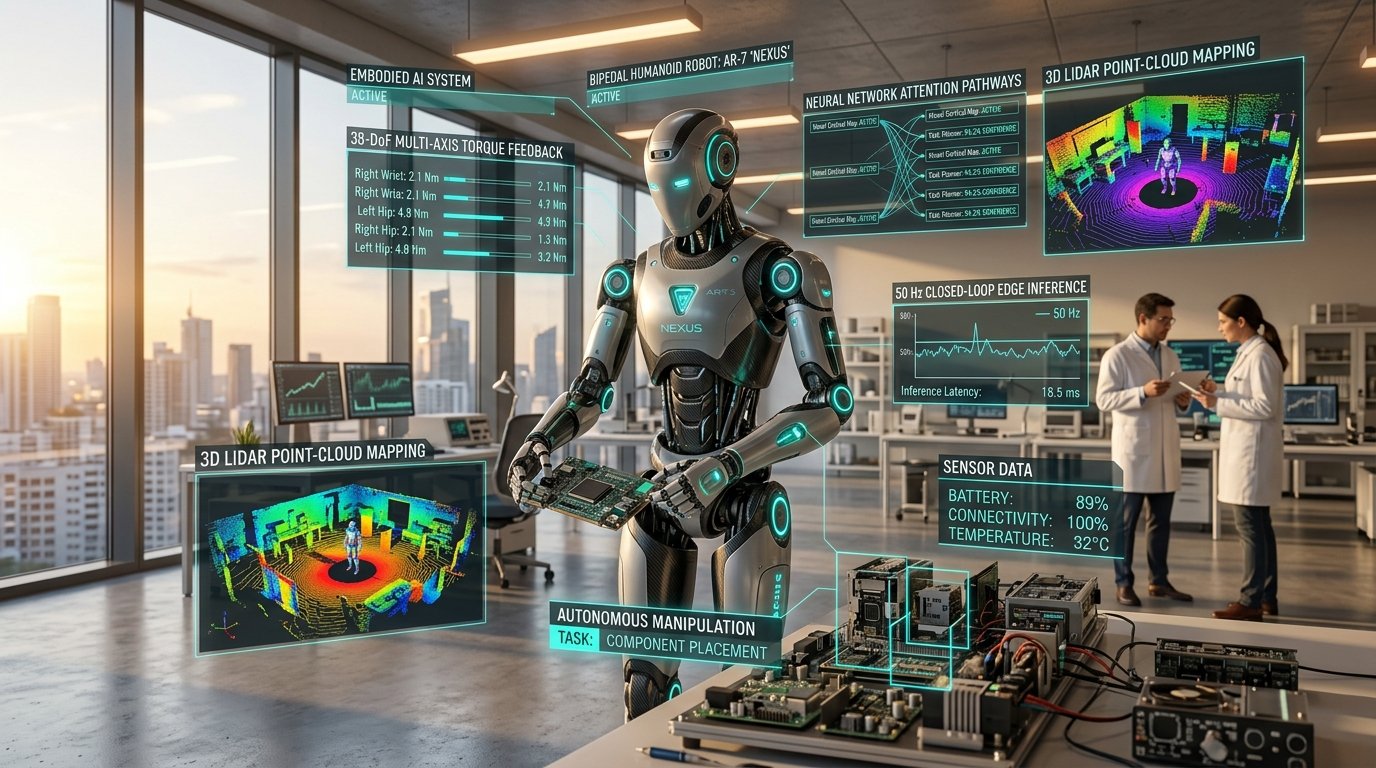
Robotics AI Systems & Models
Humanoid Hardware & AI Benchmark Comparison
Comprehensive hardware specifications, degrees of freedom (DoF), onboard AI inference engines, and operational payload capacities across leading humanoid robotics platforms.
| Robot Platform | Manufacturer | Total DoF | Height / Weight | Onboard AI & Compute | Actuator Type | Battery Life | Payload Cap. | Status |
|---|---|---|---|---|---|---|---|---|
| Figure 02 | Figure AI | 44 DoF | 170 cm / 70 kg | Dual NVIDIA Orin SoC + OpenAI Multimodal | Electric Planetary Drive | ~5 Hours (2.25 kWh) | 20 kg (5 kg / hand) | BMW Factory Pilot |
| Tesla Optimus Gen 2 | Tesla, Inc. | 28+ DoF (11 DoF hands) | 173 cm / 57 kg | Custom Tesla FSD Computer (HW4) | Custom Linear & Rotary Actuators | ~4 Hours (2.3 kWh) | 20 kg | Gigafactory Active |
| Electric Atlas | Boston Dynamics | 36+ DoF | 150 cm / 89 kg | High-Power Edge GPU + Real-Time MPC | All-Electric High-Torque Swivel | ~3.5 Hours | 25 kg (High-dynamic) | Automotive Pilots |
| Unitree G1 | Unitree Robotics | 23–43 DoF | 127 cm / 35 kg | 8-Core CPU + Dual 3D LiDAR + Depth Cam | High-Efficiency Brushless Motors | ~2 Hours | 3 kg | Commercial ($16k) |
| Digit (v4) | Agility Robotics | 30 DoF | 175 cm / 65 kg | Dual GPU + Intel RealSense RGB-D | Harmonic Drive + Spring-Loaded Legs | ~4 Hours (Swap Pack) | 16 kg (Totes) | Amazon Logistics |
The End-to-End Robotics AI Deployment Pipeline
How modern physical AI systems train, simulate, and generalize neural motion policies from digital environments to physical actuators.
Data Demonstration Capture
Engineers record multi-modal human demonstrations using ALOHA dual-arm teleoperation rigs, VR headsets, or haptic exo-suits. High-frequency joint positions, motor currents, and wrist camera video feeds are synced.
Physics Simulation & Randomization
Using NVIDIA Isaac Sim or MuJoCo, tens of thousands of digital robot clones interact with randomized lighting, friction coefficients, object weights, and unexpected disturbances in parallel GPU environments.
Action Policy Fine-Tuning
Vision-Language-Action (VLA) models combine multimodal language understanding with Action Chunking with Diffusion (ACT). The network outputs 10–50 consecutive future joint poses rather than discrete jittery steps.
Hardware-in-the-Loop Validation
The trained policy runs on actual edge compute (NVIDIA Jetson Orin) within isolated safety cages. Torque limits, velocity saturations, and kinetic boundary guardrails protect hardware from unexpected policy outputs.
Closed-Loop Autonomous Execution
The robot performs continuous tasks in warehouse aisles or assembly lines. If edge cases occur, tactile slip feedback adjusts grip pressure at 200 Hz while tele-assist operators stand by for remote intervention.
Shadow Mode & Auto-Retraining
Failed grasps or intervention triggers are tagged, uploaded to cloud data lakes, and automatically injected into the next simulation epoch, creating a self-improving physical intelligence flywheel.
Industrial Robotics Safety & ISO Standards
Deploying AI-driven autonomous robots into industrial and collaborative human spaces requires strict compliance with international mechanical and functional safety regulations:
ISO 10218-1 / -2
Global standard for industrial robots and robot system integration. Mandates safe stopping distances, protective separation monitoring, and mechanical fail-safes.
ISO/TS 15066 (Cobots)
Regulates human-robot collaborative environments. Sets precise thresholds for maximum allowable biomechanical impact pressure and kinetic force limits.
ISO 13849-1 (PLd / PLe)
Functional safety of control systems. Demands dual-channel hardware redundancies so software or neural network latency spikes cannot override physical emergency stops.
Frequently Asked Questions
Essential technical insights on modern embodied AI, foundation policies, and robotic deployment.
What is Embodied AI and how does it differ from traditional robotics?
How do Vision-Language-Action (VLA) models work?
What is the "Sim-to-Real" gap and how is it solved?
Why are humanoids emerging instead of specialized wheel-based robots?
How does WEBER CODE help teams integrate AI Robotics?
Accelerate Your Robotics & Embodied AI Initiatives
Whether you are evaluating humanoid deployments, setting up physics simulation pipelines, or developing custom Vision-Language-Action policies, our technical team is ready to assist.